In a lot of ways, everything I’m writing about in this little series could be comfortably filed under “Kitsch”, and I don’t mind that. I mean, it doesn’t bother me. I like this sort of thing – disposable pop music of the late sixties/early 70s, especially the English take on it, which was always a little bit shonkier than the American equivalent and, even in comparison to the slightly exotic, evocative of the early days of package tours of the Costa Del Sol Europop take on the same sort of thing, the English ones sounded like they’d been written and recorded in a shed on an allotment on the outskirts of Burnley in 1972.
I mean, my friends – and I still have some, despite being a middle aged man with no interest in watching sport, at least in the company of other men – wouldn’t tolerate this. My friends – who mainly consist of people I was in bands with in my younger days – scoff at most pop music of all eras. The final straw that led to my getting kicked out of the last proper band I was in may have been my insistence that Girls Aloud had better records and songs than Kings of Leon, which horrified them. Anyway, they’re all into things like Neil Young and The Rolling Stones and The Who – and fair dos, I like them all too, I just like this sort of thing as well. I don’t have any issue with manufactured pop music as a concept, and they do. You know, it’s not proper music unless the people in the band actually write their own songs and play their own instruments and all that. It doesn’t bother me whether they do or they don’t. I’m into the records. Or I’m not. Who played and wrote and sang what is of minor interest to me in comparison to whether it’s a good record or not. I’m not that picky, I suppose. Authenticity is of minor consideration to me.
Anyway, I’m not often allowed near the MP3 player if we all get together because, when I’m the DJ, it upsets people. I don’t really understand why that is, only that it does. I mean, I understand a bit – they’ve got their idea of cool which, frankly, is wrong. They’re not cool in the slightest. Some of them are in a tribute Kings of Leon band, and they think that makes them cool, which strikes me as fucking bizarre. If you’re in a tribute band, you’re not cool. Fair dos, they’re really good at it – they surprised me when I eventually saw them play. I mean, I didn’t enjoy it, but I was still impressed. If you’re in an original band, you might be cool, but you probably aren’t, even then. Even so, there’s zero possibility of being cool and being in a tribute band.
Not that I think I’m cool either, obviously. I’m a straight, white, middle aged, middle class man. Cool isn’t something that I should be concerned with, and I’m not. I wasn’t even all that cool when I was younger, although I pretended to be quite often, and for far longer than I ought to have.
Anyway, were I to DJ at some barbeque or something, I’d quite merrily put on That Same Old Feeling by Pickettywitch, and I have no trouble imagining the anguished cries of someone or other complaining about how shit it is, and why I don’t I put something good on like, I don’t know, Beast of Burden by The Rolling Stones or something.
Still, knickers to them, because That Same Old Feeling is great. And Beast of Burden’s boring.
As is usually the case in these essay things, I started off not really knowing anything about the whole caboodle, apart from liking the record, and then I think about it, and then I don’t really enjoy it half as much as I once did, so here we go, eh?
Like Beach Baby and Angelo, I don’t have any specific memories of hearing it in locally based supermarkets in the 1970s, but it’s the exactly the sort of thing that reminds me of Frank Dees and Clifford Dunns anyway. I’m not a betting man, but there’s no way that any of these records weren’t played repeatedly in either of those shops, even if I don’t specifically remember it happening. They’re all melancholy in the way that a lot of English hit singles of the early 70s were, and I like that, being a melancholic sort of person, on the whole.
Pickettywitch – apparently named after a village in Cornwall, despite no such village having ever existed – doesn’t appear to have fired the imaginations of many writers on the interweb, and consequently, I still don’t know much about them, but I can hazard a guess.

Pickettywitch were exactly the type of band who would have played “the circuit” in the late sixties/early 70s in England. They’d have played at Variety clubs – the chicken in a basket circuit – playing mainly cover versions of the big hits of the era. They had two singers – a boy and a girl – which would have made them versatile in that sort of way, and their act, and material, would have been similar to hundreds of other similar sorts of bands of the time. The girl singer was Polly Brown who, Wikipedia informs me, Jimmy Savile claimed to have been engaged to as a cover for his necro/paedophilic tendencies.
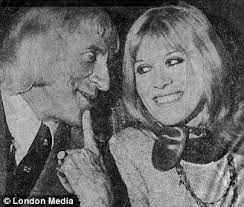
Polly was a bonny lass, but not too bonny. I mentioned this in the entry about Angelo: the tendency for girls in English bands of the era to be attractive, whilst not being so attractive as unattainable. I mentioned Raquel Welch as unattainable, and I stand by that. I suppose “Girl next door” covers it. Good looking without being too perfect, very much like the records they sang were too. Polly, from a certain angle, looks like the perfect English version of the hippy chick, all blonde hair, fringe and elaborate eye makeup. From another angle, she has a touch of the lantern jaw, protruding jaw thing going on – the sort of thing that would make her a shoo in for a minor role in Crossroads, but would immediately exclude her from being, say, a Bond girl who gets suspended in brine in a tuna factory in Osaka by a villain who lives in a lair beneath a dormant volcano. She’s got the perfect voice for this sort of thing too. It’s gentle and mild. Not so much gentle and mild like Jesus, as a reasonably priced soap made in the home counties in 1968.

There’s a boy singer who doesn’t do too much on this record, although he and Polly endearingly have a stab at a couple of slightly choreographed dance moves which, like Bananarama’s a decade later, would emphasise the homemade nature of the whole thing. They’re hardly Michael Jackson’s backing troupe, synchronised to the millisecond, and they’re all the better for not being that.
The song That Same Old Feeling was written by John McCleod – who’d previously written Baby, Now That I’ve Found You for The Foundations, and Heaven Knows I’m Missing Him Now, the Sandie Shaw hit that inspired The Smiths’ pun twenty years later. Both of which share a certain stuttering, clunkiness and they falter from verse to chorus and back again – and Tony Macauley, who co-wrote Baby, Now That I’ve Found You with McCleod, plus Build Me Up, Buttercup (with Mike D’Abo from Manfred Mann), and also Love Grows Where My Rosemary Goes for Edison Lighthouse (sung by Beach Baby’s lead vocalist, Tony Burrows).
Presumably, as the two writers had enjoyed success with The Foundations, That Same Old Feeling had been originally recorded by that group too.
It’s all there, isn’t it? The song, I mean. There’s nothing drastically different about it. The singer does what singers often do with melodies – he fucks about with it slightly in terms of slight pauses for dramatic effect, when it would be better if he didn’t – and the backing is slightly harder edged, like the English take on blue eyed soul that The Foundations were, but it also doesn’t really work because That Same Old Feeling is a small song of gentle, as opposed to grunting, yearning. The Foundations were bubblegum, but the impression I get is that they sort of thought they were soul. Proper soul. Otis Redding soul. Soul that involved a lot of sweating and testifying, and That Same Old Feeling isn’t about any of those things because it’s about hiding your pain, a private sort of nagging agony, rather than the sort of pain you’d get down on your knees about in Las Vegas and testify about with a horn section thundering behind you. The main reason for that is because of the bucolic nature of the lyrical imagery.
Starting off with the chorus, which does that Smiths/Pet Shop Boys thing of sounding simultaneously happy and sad, it’s pretty straightforward. We know what’s happening here – a couple have broken up and one of them can’t get over the other. Same old story, same old feeling, eh? The word “yearning” crops up, and I’m glad it does, because that’s what the record sounds like.
First verse, and it’s a bit like Walk Away Renee’s “your name and mine inside a heart upon a wall”, except this is just the narrator’s name, and it’s not on an urban wall because it’s on an “oak tree”. A good old fashioned English oak tree. The narrator sings about “the cottage” that’s now “overgrown”. Oak trees with a girl’s name carved into it, a cottage that they planned to live in is overgrown and neglected, a pathetic fallacy – and it’s English as you can imagine. And, when I say “English”, I mean my idea of Englishness, which is about rain, trees, cups of tea, old films, libraries, The Beatles and tutting, as opposed to some people who go on about Englishness, who mean things like football hooliganism, wilful stupidity, anti-intellectualism, casual violence, braying, fox-hunting and boorishness, all of which I’m very much against.
You know what this is about: it’s about a relationship founded in the countryside of England, among mighty oaks and quaint cottages. Probably in the rain. When the couple broke up, I don’t think of them having a flaming row, so much as an unspoken misunderstanding. More Brief Encounter than Kramer Versus Kramer.
Nobody’s going to be popping any caps in anyone’s ass anytime soon. Even the sound of the nearest city is a distant, frightening thing, let alone Fort Apache, The Bronx. . The air quality is good, there’s a babbling brook not far from there, with moorhens and ducks, that burbles past a sandstone church with graves from 400 years ago, and a tea room – not a café – that serves tea and sticky buns, as opposed to cappuccinos and quiches and, while there might well be a jukebox in said establishment, it’ll be stocked with the gentler 7 inch singles of The Zombies, The Kinks and Mary Hopkin.
And, as I’ve said, what that means is no testifying, no sweating, no grunting – no American takes on heartbreak. This is England, and this is what English heartbreak sounds like.
What that means is that you don’t make a big deal of it. Ideally, you don’t even mention it to anyone or, if you do, you make out everything’s alright, and what are you bringing that up for? Him? I can’t even remember going out with him. Did I? Are you sure? Ah well. Oh, look, was that a badger waddling past the Post Office? Then you go home, put the kettle on, draw the curtains, and turn on the black and white afternoon film on BBC2 loud enough so that your elderly neighbours can’t hear you crying into your impeccably brewed tea about what might have been.
Which is why Pickettywitch’s version of it’s the best one, because they are that. Or, even if they’re not intentionally that, they can’t help doing that to it.
Pickettywitch had the biggest hit with this – as well they might have – especially in England – as it should have been – and it did pretty well around the world too. It didn’t set America on fire, but that might be because The Fortunes released their version of it on the same day in America. The Fortunes were a pretty nunty English group, most famous for “You’ve Got Your Troubles”, which always sounded a bit finger wagging, as opposed to finger pointing to me. The Fortunes weren’t as soulful as The Foundations were, and The Fortunes’ version is sort of midway between The Foundations and Pickettywitch’s.
I mean, it’s alright, isn’t it? The bass is a bit too strident and, on the whole, it’s got that puppy dog, slightly too eager to please thing going on. I suppose, given the lyrics, that could have worked, but it doesn’t really.
What Polly Brown had, apart from a slightly protruding jaw, a button nose, and nice hair, was a bit of a gormless look about the eyes. Not unappealingly so, but enough to give the viewer the sense that while she might have been having a go at remembering some rudimentary dance routines with her co-singer, in her mind, she was somewhere else entirely. Not thinking about anything deep so much as just drifting off a bit. Which suits this record down to the ground, doesn’t it? Yeah, she’s on the telly, singing a hit pop record, but that slightly vacant look in her eyes tells us that maybe she’s there in body, but not so much in spirit, because, maybe, deep inside her heart, she’s standing beneath an ancient oak tree in a village near Yeovil, with the rain dripping down from her slightly prominent chin as she’s looking up at the fading scratches that read “Polly” on the trunk, thinking about how things might have been.
That’s records and singers for you though, isn’t it? Some singers just suit certain songs, and Polly Brown suits That Same Old Feeling in ways that the other people who’ve sung it just don’t. Maybe it’s the look on her face, maybe it’s her features, maybe it’s her delicate, kind sounding voice. I don’t know what it is exactly, but whatever it is, it works.
When I think of Pickettywitch, my brain connects them with Shocking Blue, probably because they’re both sort of Chicken in a basket Variety Club bands with girl singers who had elaborate eye makeup – even though Shocking Blue were Dutch. And it’s odd, because Shocking Blue – and their big hit Venus (which is also fantastic, probably a better record than this, if you ask me) – are nothing like Pickettywitch and their big hit – this. The similarity in my mind is that each girl’s voice suits the song they’re known for so well, that they couldn’t really do anything else afterwards and it still work.
The girl from Shocking Blue’s strong mainland European accent makes Venus work for them when it didn’t really for Bananarama – much as I enjoy some of their other records too. Venus is an exotic sounding record, about an exotic woman, and you need an exotic voice for that. Pickettywitch couldn’t have sung Venus and Shocking Blue couldn’t have sung That Same Old Feeling. I guess that’s what A&R men did – match material to singers.
So, Pickettywitch? Nobody could have sung this any more effectively than Polly Brown, and, had the producers made it any more slick, or had the choreographer – if there even was one – insisted on polishing the moves they displayed on the episode of TOTP I’ve linked to at the top of this post, it would have been no better and much worse for it. As it stands, the Englishness – the nice Englishness, the shonkiness, the quiet vulnerability and, most of all, the sense of not wanting to make a big deal out of your own personal heartbreak and that stiff upper lip implied in the words, music and performance all combine to make That Same Old Feeling by Pickettywitch absolutely and utterly redolent of early 1970s dark, rainy evenings in England. For the likes of idiots like me whose brains churn this sort of shit out, anyway.
 MiddleRabbiting